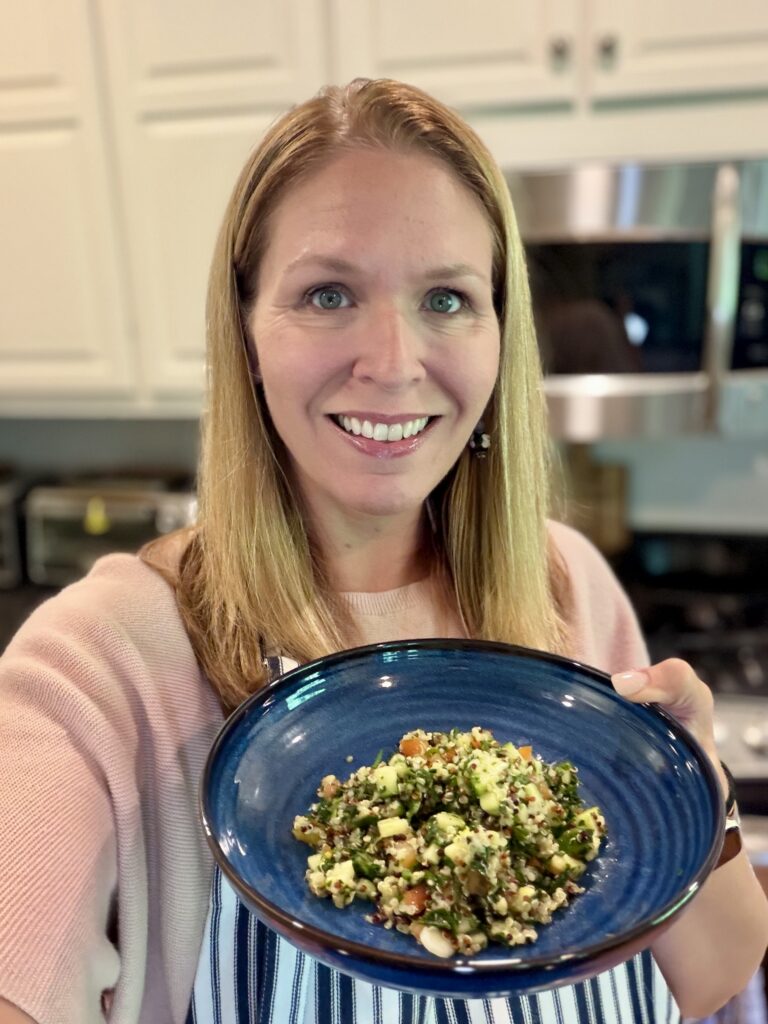
The Hormone-Friendly Lunch Bowl You’ll Want All Summer (Quinoa Tabbouleh)
Tabbouleh is one of my favorite summer foods.
Fresh, herby, bright — it’s everything I want when it’s hot outside and I need something that actually feels good to eat. The parsley, the mint, the lemon. There’s nothing quite like it.
But traditional tabbouleh is made with bulgur wheat, which isn’t gluten-free and doesn’t work for our family anymore.
So I made it with quinoa instead. And honestly? I like it better.
It’s still everything I love about the original — that refreshing, Mediterranean flavor that tastes like summer in a bowl — but now it actually supports my hormones instead of working against them.
That’s what I’m sharing with you today. The recipe, and the reason it works.
Why Most Lunches Work Against Your Hormones
Here’s what I see in a lot of my clients: they eat “healthy” lunches — a wrap, a sandwich, even a big salad with croutons — and by 3pm they’re exhausted, craving sugar, or riding an anxiety spike they can’t explain.
Sound familiar?
The culprit is usually one of two things:
Gluten + blood sugar spikes. Traditional grains like wheat (including bulgur, the grain used in classic tabbouleh) can cause rapid blood sugar fluctuations. When your blood sugar spikes and crashes, your adrenal glands respond by pumping out cortisol to stabilize it. If your cortisol is already dysregulated — which is true for most burned-out women — this creates a compounding stress cycle your body can’t easily recover from.
Not enough protein or fat. A lunch that’s mostly carbs, even healthy carbs, leaves your blood sugar unstable and your hunger hormones (ghrelin and leptin) out of sync. You need protein and healthy fat to anchor the meal and keep cortisol steady through the afternoon.
This recipe solves both problems.
What Makes This Recipe Hormone-Friendly
Quinoa instead of bulgur wheat
Quinoa is naturally gluten-free and a complete protein — meaning it contains all nine essential amino acids. Unlike wheat, it has a much lower glycemic impact, which means a steadier blood sugar response and less cortisol demand from your adrenals.
It’s also rich in magnesium, a mineral that’s often depleted in women with chronic stress. Magnesium plays a direct role in regulating the HPA axis — the hormonal communication system between your brain and adrenal glands.
Parsley — not just a garnish
Most tabbouleh recipes call for a lot of parsley, and that’s actually one of its best features from a hormone perspective. Parsley is rich in apigenin, a flavonoid that supports estrogen metabolism and liver detox pathways. Your liver is responsible for clearing excess estrogen from your body. When it’s overburdened, estrogen dominance symptoms — bloating, mood shifts, heavy periods — can worsen. Parsley is a small but meaningful way to support that process every day.
Olive oil + lemon
This classic combo is more functional than it looks. Extra virgin olive oil is one of the most anti-inflammatory foods available and supports healthy cell membrane function — critical for hormone receptor sensitivity. Lemon supports bile production, which aids in the absorption of fat-soluble vitamins like D, E, K, and A — all of which play roles in hormone production and balance.
Cucumber and tomatoes
Both are hydrating, anti-inflammatory, and gentle on a stressed nervous system. Dehydration — even mild — is a physical stressor that triggers cortisol release. Eating water-rich vegetables throughout the day is one of the simplest ways to reduce your cortisol load.
Want to Make It Even More Hormone-Supportive?
A few easy add-ins that take this to the next level:
- Grilled chicken or salmon — the easiest way to turn this into a complete meal. Both are excellent protein sources that support cortisol balance and keep you full and steady through the afternoon. Just add on top before serving.
- ½ cup chickpeas — extra fiber and plant protein for sustained blood sugar stability
- A handful of arugula — additional liver support and a peppery kick
- A sprinkle of pumpkin seeds — one of the best food sources of zinc, which is essential for progesterone production
The Bottom Line
You don’t need a complicated protocol to start supporting your hormones at lunch. Sometimes it’s as simple as swapping bulgur for quinoa, piling in the parsley, and dressing it with real olive oil and lemon.
Small, consistent choices add up — and they add up faster than you think.
If you’re ready to go deeper and actually get to the root of what’s throwing your hormones off, I’d love to support you inside my coaching program. You can learn more at hollyandrewscoaching.com/coaching.
Have you tried this recipe? Drop a comment below and let me know what you think — or tag me on Instagram so I can see your creation!
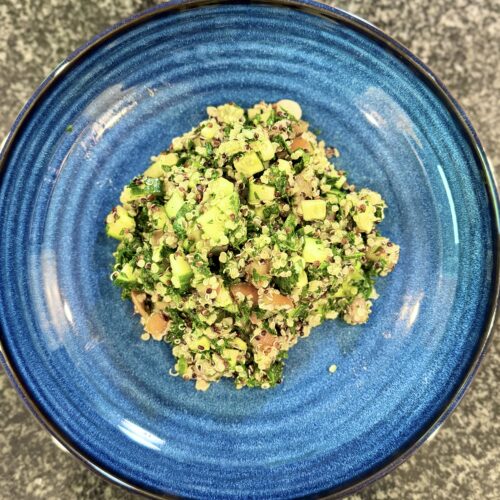
Quinoa Tabbouleh
Equipment
- large bowl
- small saucepan with lid
- Baking sheet or wide bowl (for cooling quinoa)
- Sharp Knife
- cutting board
- Small bowl or jar (for dressing)
- Whisk or fork
- measuring cups and spoons
- Citrus juicer or reamer (for the lemons)
- Zester or microplane
Ingredients
For the tabbouleh:
- ¾ cup dry white quinoa rinsed
- 1½ cups water or low-sodium broth
- 2 cups fresh flat-leaf parsley finely chopped
- ½ cup fresh mint leaves finely chopped
- 1 English cucumber diced small
- 2 Roma tomatoes seeded and diced
- 4 green onions thinly sliced
For the dressing:
- 3 tablespoons extra virgin olive oil
- 4 tablespoons fresh lemon juice about 2 lemons
- 1 teaspoon lemon zest
- 2 garlic cloves minced
- ¾ teaspoon fine sea salt
- ¼ teaspoon black pepper
- ¼ teaspoon ground cumin optional, but lovely
Instructions
- Cook the quinoa. Combine quinoa and water (or broth) in a small saucepan. Bring to a boil, then reduce heat to low, cover, and simmer for about 15 minutes until all liquid is absorbed.
- Cool completely. Fluff with a fork and spread onto a baking sheet or wide bowl. Don't skip this step — hot quinoa will wilt the herbs and make the whole thing mushy.
- Make the dressing. Whisk together olive oil, lemon juice, lemon zest, garlic, salt, pepper, and cumin. Taste and adjust as needed.
- Chop everything. Finely chop the parsley and mint — the finer the better for true tabbouleh texture. Dice cucumber and tomatoes small, slice the green onions.
- Combine. Add cooled quinoa to a large bowl with the herbs and vegetables. Pour dressing over and toss well.
- Let it rest. Give it at least 15 minutes before serving so the flavors can meld. Serve chilled or at room temperature.
Video
Notes
- Quinoa is a complete protein with all essential amino acids — great for blood sugar balance and keeping cortisol steady between meals.
- Parsley is a powerhouse for estrogen metabolism — it supports liver detox pathways that help clear excess hormones.
- Olive oil + lemon combo supports bile production and fat-soluble nutrient absorption.
- Cucumber & tomato are hydrating and anti-inflammatory — gentle on adrenals.
- Protein: 7g
- Carbohydrates: 32g
- Fat: 14g
- Fiber: 5g