
The Greek Salad You’ve Never Actually Had
A few weeks ago, I was in Oia — the village in Santorini with the blue domes and the sunsets everyone flies halfway across the world to see — and we ducked into a cute little restaurant called Kookoo for lunch. It was scorching hot that day, but they had a great breeze going and even better service. I love a Greek salad, so that’s exactly what I ordered, along with some tzatziki and saganaki. And when the salad arrived, I realized everything I thought I knew about Greek salad was wrong.
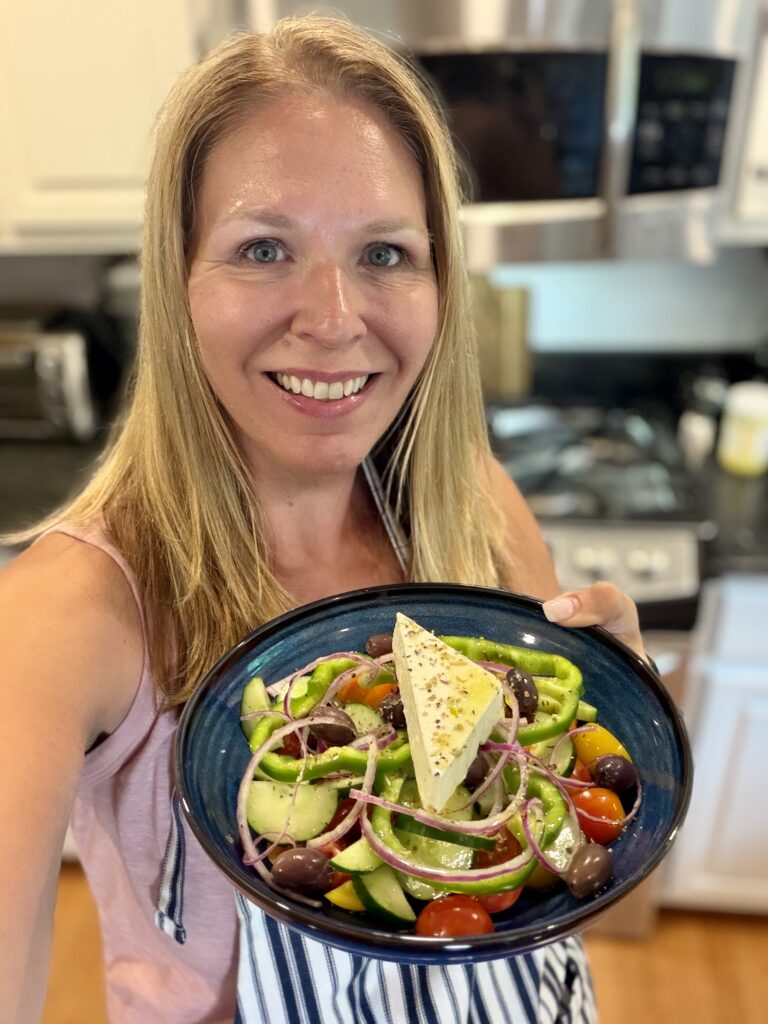
No lettuce. Big slabs of feta, not crumbled. Tomatoes so ripe they didn’t need anything else. Our guide had told us something earlier that day I hadn’t stopped thinking about since: what Americans call “Greek salad” — lettuce, a sprinkle of feta, a few olives tossed in — isn’t really Greek at all. The real one, horiatiki, doesn’t hide behind lettuce. It’s just a handful of perfect, simple ingredients doing all the work.
I came home determined to recreate it exactly as I had it, and once I dug into the ingredients, I realized this isn’t just a beautiful salad — it’s actually a smart one for anyone dealing with blood sugar swings or cortisol overload (aka most of us, most days).
Why this salad works harder than it looks
We talk a lot around here about how the food on your plate either steadies your blood sugar or spikes it. A lettuce-based salad with a light vinaigrette is mostly water and fiber-free crunch — it fills your plate but doesn’t do much else. Horiatiki is the opposite. Between the olive oil, the whole block of feta, and the olives, you’ve got real fat and protein sitting alongside the vegetables, which slows down how fast everything hits your bloodstream. That’s the difference between a salad that leaves you hungry in an hour and one that actually holds you.
The ingredients, and why they’re all here on purpose
Tomatoes — Ripe, in-season tomatoes are the backbone of this salad, and there’s a reason the recipe leans on them so heavily instead of masking them with lettuce or heavy dressing. They’re doing real work here, not just filling space.
Cucumber — Adds water content and a cooling crunch that balances the richness of the olive oil and feta.
Green bell pepper and pepperoncini — This was the ingredient I didn’t expect. In the States, “Greek salad” rarely includes pepper, but in an actual Greek village, it’s standard. It adds a little sharpness that cuts through the fat.
Red onion — Thin slices for bite, not overwhelm.
Kalamata olives — Another source of healthy fat, and non-negotiable for authenticity.
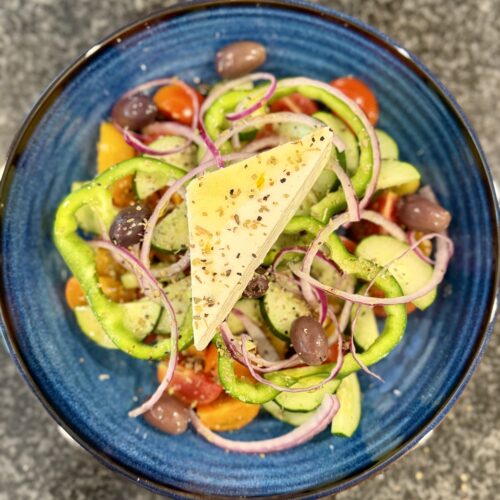
Feta, whole — This is the detail that changes everything. Keeping the feta in one block instead of crumbling it isn’t just for presentation — it means every bite has the option of real, substantial protein and fat, instead of a light dusting that barely registers.
Olive oil — The finishing touch, and honestly, close to the whole point of the dish. A good olive oil is anti-inflammatory and it’s what makes this salad feel indulgent instead of like diet food.
Oregano — Dried Greek oregano, sprinkled generously right at the end. This is the flavor that makes it taste like Greece and not like a salad bar. Skip it and you’ll notice something’s missing even if you can’t name it.
A couple of practical tips
- Buy the ripest tomatoes you can find. This salad has nowhere to hide, so ingredient quality matters more here than in almost anything else you’ll make this summer.
- Don’t crumble the feta. I know it’s tempting, but the whole block is correct, and it’s a small thing that makes the dish look and eat completely differently.
- Serve it immediately after dressing — this isn’t a make-ahead salad. The tomatoes will release water the longer it sits.
Swaps if you need them
- No pepperoncini on hand? Banana peppers work in a pinch.
- Dairy-sensitive? A dairy-free feta alternative will get you close, though the real thing is worth seeking out if you can find good feta locally.
- Want more staying power? Add a handful of chickpeas — not traditional, but it turns this into a full lunch.
If you make this one, I want to hear whether it changes how you think about “Greek salad” the way it changed mine. And if you’re looking for more ways to build meals that support your nervous system instead of destroy it, that’s exactly what we work on together — you can read more at hollyandrewscoaching.com/coaching.
Authentic Greek Village Salad (Horiatiki)
Equipment
- cutting board
- Sharp Knife
- Large serving platter or shallow bowl
Ingredients
- 4 large ripe tomatoes cut into thick wedges
- 1 English cucumber cut into thick half-moons
- 1 green bell pepper sliced into rings
- 1/2 red onion thinly sliced
- 1/2 cup Kalamata olives
- 4-6 pepperoncini optional
- 6 oz feta cheese in one block (not crumbled)
- 1/4 cup extra virgin olive oil
- 2 tablespoons dried Greek oregano
- 1 teaspoon sea salt
- 1/2 teaspoon black pepper freshly cracked
Instructions
- Arrange the tomatoes, cucumber, bell pepper, red onion, olives, and pepperoncini on a large platter or shallow bowl. Don't toss — layer them so everything stays visible.
- Place the block of feta whole on top of the vegetables. Do not crumble.
- Drizzle the olive oil evenly over the entire salad.
- Sprinkle the oregano generously over the top, followed by the salt and pepper.
- Serve immediately with crusty bread on the side, if desired, letting everyone break into the feta themselves at the table.
Notes
- The feta stays whole in authentic horiatiki — this isn’t a mistake, it’s tradition. Crumbling it is one of the biggest differences between the real version and the Americanized one.
- No lettuce is correct. If a Greek salad recipe calls for lettuce, it’s not truly horiatiki.
- Best made with the ripest tomatoes you can find — this salad has nowhere to hide, so ingredient quality matters more than technique.
- Calories: ~240
- Protein: 7g
- Fat: 20g
- Carbohydrates: 11g
- Fiber: 3g


